
Watertown Criminal History Checks
Start a Watertown criminal records search by naming the kind of event and the office that created it. The Watertown Police Department keeps its incident, arrest, crash, dispatch, and video records. Watertown Municipal Court keeps city ordinance and traffic citation matters. A state criminal prosecution is filed in the Circuit Court for the county where the conduct occurred. Wisconsin DOJ then receives qualifying fingerprint-supported arrest and disposition data for its person-centered repository.
- Ask Watertown Police for the incident, arrest, crash, call, or media record using the report number when it is known.
- Give the records clerk the date, place, involved names, birth dates, incident type, and requester contact and billing details.
- Contact Watertown Municipal Court for a city traffic or ordinance citation and include the ticket number, name, and address.
- Identify whether the incident occurred in Dodge or Jefferson County, then search the correct Circuit Court and custody channels.
- Use WORCS when a statewide Wisconsin name-based repository response is needed.
Each step tests a different Watertown record pool. A Watertown police narrative can exist before any prosecutor files a charge. A city citation can remain noncriminal from start to finish. WCCA can show the public state-court docket, but it does not supply the Watertown police report or document images. WORCS is broader than one city yet may omit a local event that was not fingerprinted or has not reached the repository.
Watertown Police Record Channels
The Watertown Police public-records page documents a notably broad set of access routes. A request may be made at the counter, by email, by fax, or by mail. Phone contact with the records clerk helps a requester identify what to send, while a written request creates a clear list of the items sought. The clerk works at 106 Jones Street and can be reached at 920-206-4219, pdrecords@watertownwi.gov, or fax 920-262-9710. Counter hours are 8 a.m. to 4 p.m.
The official source shows how Watertown organizes those Watertown record choices.
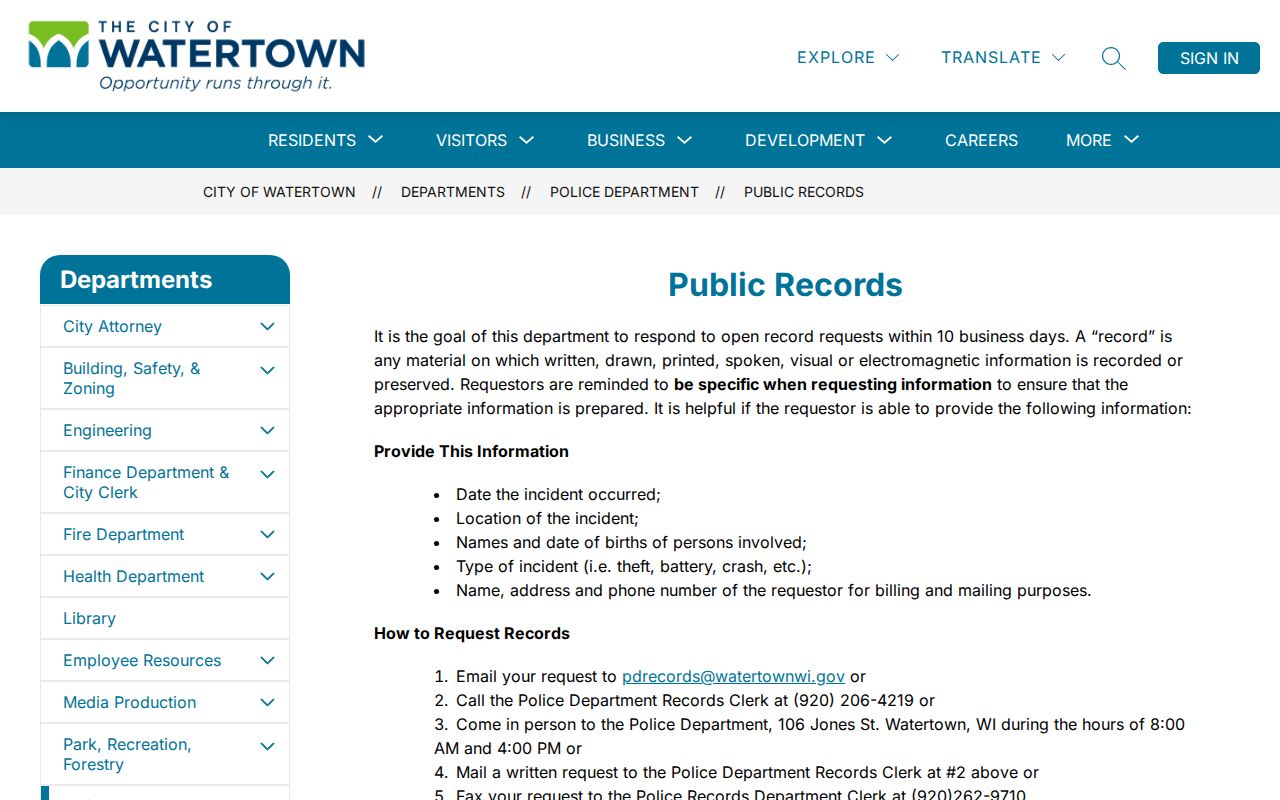
The image reinforces that Watertown records are obtained from the Watertown custodian, not from an unofficial people-search service. Use a precise Watertown request. State the incident date and location, the people involved and their birth dates, the type of event, a report number if available, and a reliable billing address. Those details help distinguish similar names and reduce the chance that staff must seek clarification.
Records at the Watertown Police Department
Watertown Police owns the agency file for an event handled by its officers anywhere within the city. That file may include a narrative report, crash record, dispatch or 911 audio, radio traffic, intelligent video, and squad or body-camera media. It is not the same as a jail booking or a court file. The police report records what officers saw, learned, and did. The prosecutor later decides whether state charges should be filed, amended, or declined.
Watertown black-and-white paper reports cost $0.25 per page. A Watertown 911 recording, radio communication, intelligent video, squad video, or body-camera recording costs $20 per incident. USB media and shipping use standard charges. A motor-vehicle record can also trigger Driver's Privacy Protection Act requirements. Watertown may require its Permissible Use Form and Driver Protection Act waiver before protected DMV-derived data can be disclosed.
Watertown Police Records
106 Jones Street
Watertown, WI 53094
920-206-4219
Monday through Friday, 8 a.m. to 4 p.m.
Email: pdrecords@watertownwi.gov
Fax: 920-262-9710
Note: A city police report describes an investigation or arrest; it does not establish that a court entered a conviction.
Watertown Records Timing Matters
Watertown targets a response within ten business days. That is a local service goal, not a promise that every file will be released in full by the tenth day. A large video request, an active case, juvenile material, victim privacy, or protected driver information can require review and redaction. Wisconsin Public Records Law instead requires a response as soon as practicable and without delay. If a request is too broad, naming the precise report or recording can help.
Watertown body-camera timing deserves special care. Ordinary Watertown recordings have a stated minimum retention period of 120 days, and each recording is tied to a Watertown police case number and evidence chain. A person seeking their own incident video should request it early, describe the date and place, and identify the officers or case number when possible. Waiting can matter even when a written report remains available longer.
| Watertown item | Charge or timing |
|---|---|
| Black-and-white report | $0.25 per page |
| 911 or radio recording | $20 per incident |
| Squad, body camera, or intelligent video | $20 per incident |
| Response target | Within ten business days |
| Ordinary body-camera retention | At least 120 days |
Booking and Arrest Records in Watertown
A Watertown arrest produces more than one record. Watertown Police creates the incident or arrest report. The jail that receives the person creates the intake file, bond or hold entry, and release record. Qualifying fingerprints can be sent to Wisconsin DOJ's Crime Information Bureau. If a prosecutor files a state charge, the correct Circuit Court creates a CF, CM, CT, or other case docket.
The Watertown county line controls the last two local steps. A Watertown arrest on the Dodge County side may lead to the Dodge County Detention Facility and Dodge County Circuit Court. An event on the Jefferson County side follows Jefferson County custody and court channels. Watertown does not turn those county records into one citywide jail list. For a Dodge-side event, the Dodge County arrest search options explain the sheriff app, jail phone, VINELink, agency request, and court fallback.
Recent police facts may appear first in the city report. Filed charges appear later, if the prosecutor acts. Always compare the disposition rather than treating an arrest allegation as guilt.
Watertown Records Follow Incident Location
The most common Watertown routing error is choosing a county from the Watertown name alone. Watertown's citywide population spans Dodge and Jefferson Counties. Watertown police service is citywide, so WPD remains the right report custodian on either side. Yet detention and Circuit Court jurisdiction turn on where the event occurred. A Watertown address, intersection, police case number, citation, or complaint can help establish that location.
Use WCCA with the correct county filter after identifying the place. Search by case number when available; otherwise, use name and birth date with care. WCCA shows charge rows, pleas, dispositions, sentence events, and future hearings, but not the complaint PDF or police evidence. For a Dodge-side filed case, the Clerk of Courts supplies copies through the channels described in the Dodge County court case lookup.
County-line caution: A no-result search under Dodge County does not rule out a Watertown case filed in Jefferson County.
The Watertown Municipal Court File
Watertown Municipal Court has exclusive jurisdiction over noncriminal city ordinance violations, including municipal traffic and local regulatory matters. Judge Mark S. Sweet and clerk Debbie Schuett work at 106 Jones Street, Room 2065. The clerk's number is 920-206-4203 and fax is 920-206-4225. Hours are Monday through Thursday, 8 a.m. to 4 p.m., and Friday, 8 a.m. to noon. No public municipal case-search database was found, so the court clerk is the direct access point.
The official Watertown Municipal Court page distinguishes its citation work from state criminal court.
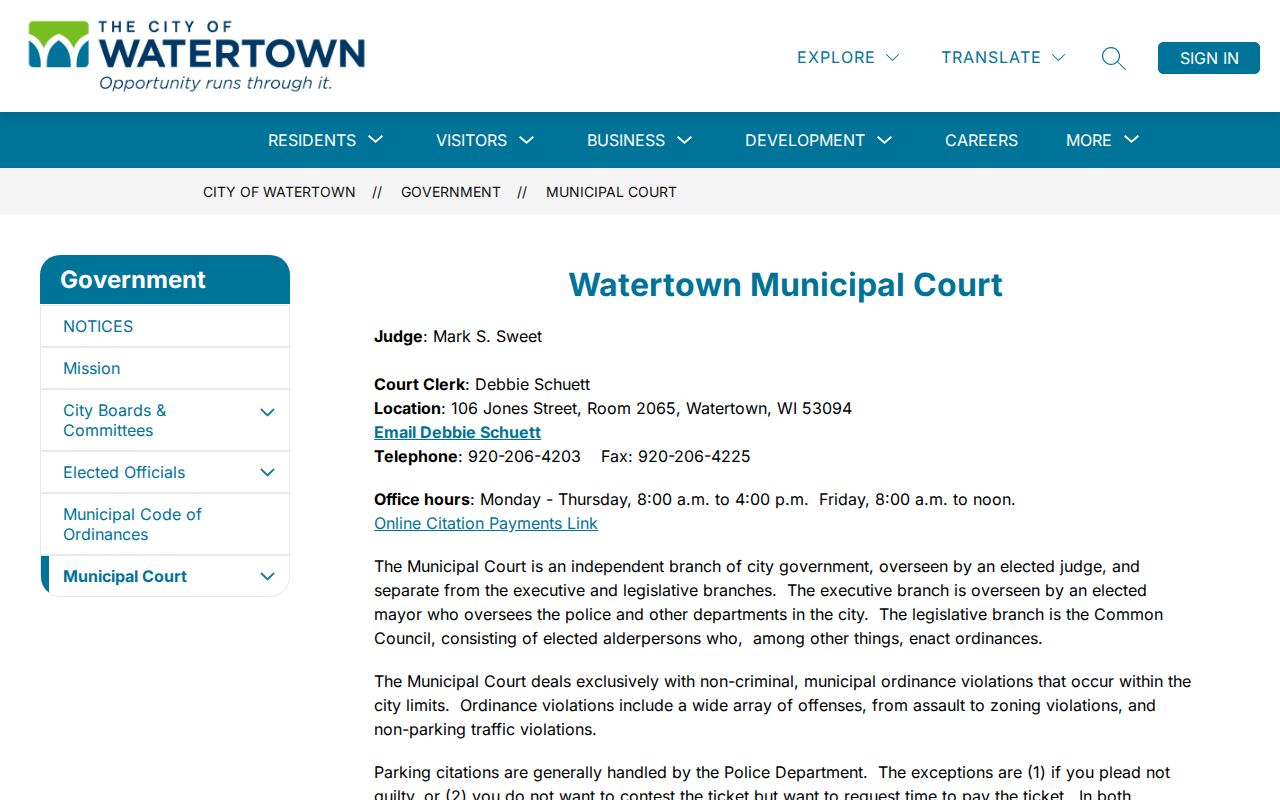
The court image marks the Watertown forum for ordinance and traffic matters. Watertown correspondence should include the ticket number, name, and address. Initial appearances are offered at 10:30 a.m. or 5:30 p.m. A Watertown municipal finding can result in a forfeiture, but it is not a Wisconsin misdemeanor conviction.
| Court Name | Watertown Municipal Court |
|---|---|
| Case Types Heard | Noncriminal city ordinance, traffic, and local regulatory citations |
| Case Lookup Channel | Clerk counter, phone, fax, or written correspondence; no public municipal database identified |
| What the File Shows | Citation, plea, scheduled appearance, municipal disposition, and payment information |
| Copies & Fees | Ask the municipal clerk for the current cost and available format |
Watertown Parking Records Take Another Route
Parking citations expose a small but useful Watertown distinction. They ordinarily stay with the Police Department rather than moving at once to Municipal Court. A not-guilty plea or request for more time to pay can change that route. Sending every parking question to the court clerk can therefore delay an answer, while treating a parking citation as a state criminal case can produce a misleading WCCA search.
Begin with Watertown Police and provide the ticket number, vehicle details, name, and current address. If staff says the matter has moved to Municipal Court, then contact the court clerk. The handoff is based on the citation's status, not on a broad label such as “criminal record.”
How Watertown Records Reach the County
A Watertown event stays at city altitude until another legal step occurs. WPD keeps its own Watertown report and evidence. A Watertown municipal citation remains in the city court track. A state-law allegation goes to the prosecutor for the county of occurrence. If charges are filed, the Circuit Court clerk opens the official case. Courts and corrections agencies later report eligible dispositions and supervision events to Wisconsin DOJ CIB.
Record flow: Watertown Police › correct county Circuit Court › Wisconsin Department of Justice Crime Information Bureau
That flow explains why one search may be current while another still shows nothing. Ask WPD for the newest city incident. Use Municipal Court for the local citation. Use the county clerk for the filed case and actual court documents. Use WORCS for the statewide person-centered response, while remembering that it is not a national search and may not include every local or federal event.
Watertown Park Citations Changed in 2025
A local enforcement change shows why Watertown municipal records are not frozen in time. An ordinance effective April 15, 2025 bars smoking and vaping within 25 feet of listed parks and recreation areas. Watertown Police enforces the rule through municipal citations. Those matters belong in the city citation channel, not in a search for Dodge County felony or misdemeanor cases.
The city's ordinance notice provides the effective date and scope. A person reviewing a citation should retain the ticket number and use the Municipal Court contact if contesting it. This local change also demonstrates why the incident date matters when a clerk searches Watertown records.
Watertown Police Records Across Time
Watertown began as Johnson's Rapids and was settled in 1836 near Rock River water power. River geography shaped the city long before modern county databases. An 1881 flood removed a structure at the first-engine-house location, while later city growth crossed the Dodge and Jefferson County boundary. That history gives present record routing a physical explanation: the city is one police jurisdiction, but it is not one county court jurisdiction.
The Watertown Police history source places the department's work in that longer city story.
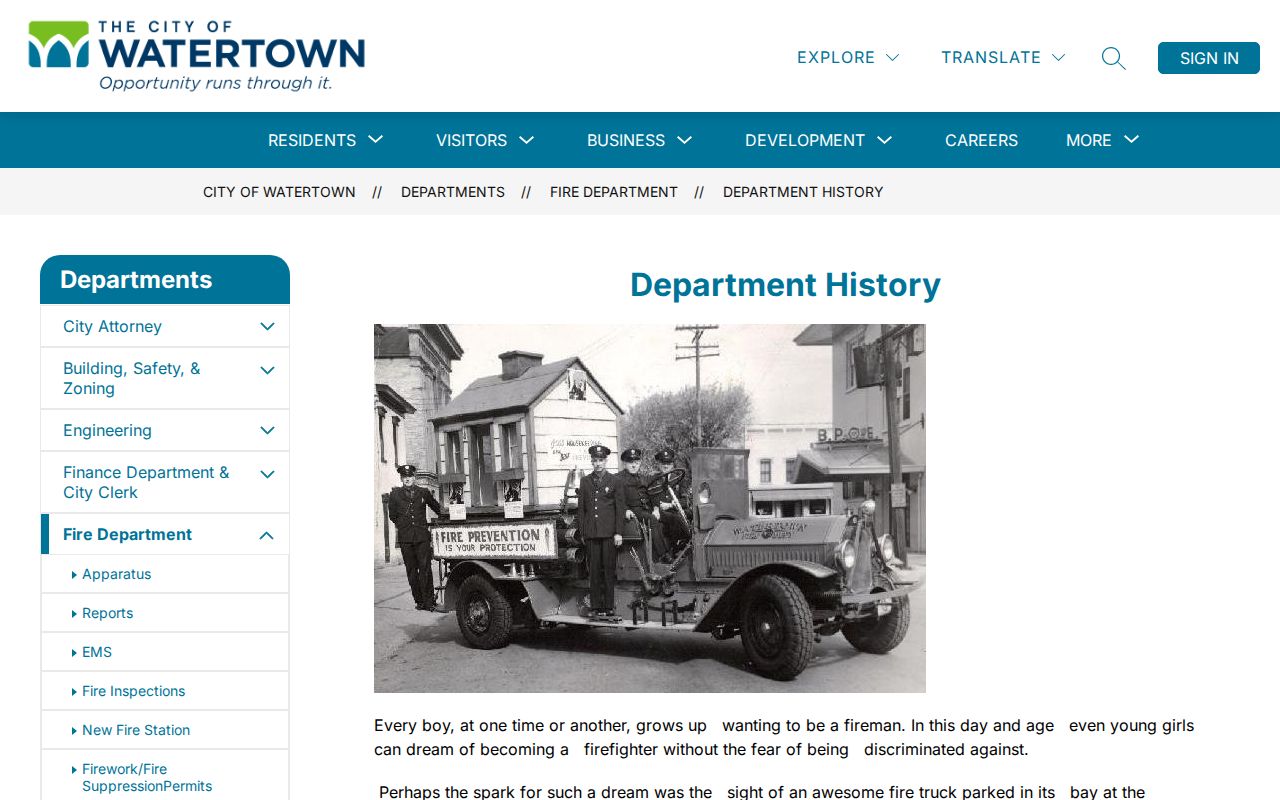
The historic view adds context without replacing the official modern channels. Older city material may require archival research, while a current report still belongs with the Police Department and a filed state case still belongs with the proper county clerk.
Watertown Record Access Rules
Wisconsin begins with a strong presumption that public records are open, but access is not absolute. Watertown must apply specific confidentiality laws and the common-law balancing test. Active investigations, juvenile records, victim or witness privacy, and protected identifiers can be withheld or redacted. A partial release is often possible when exempt details can be removed. The records custodian should state the legal reason for a denial.
Driver data deserves separate attention because police reports can contain DMV-derived details. A DPPA form or waiver does not turn the request into an automatic release. It documents the asserted lawful basis, and the custodian still reviews the record. A narrow request for a named report or media item is more useful than asking for every Watertown criminal record tied to a person.
Key Statutes:
Wisconsin Public Records Law, Wis. Stat. §§ 19.31–19.39 creates the access presumption, subject to statutes, balancing, and lawful costs.
Wis. Stat. § 165.83 governs fingerprint and criminal-history reporting to Wisconsin DOJ.
Wis. Stat. §§ 801.19–801.21 protects personal identifiers and supplies the court process for sealing or redaction.