
Dodge County Sex Offender Checks
The official starting point is the Wisconsin Public Sex Offender Registry, also branded Wisconsin Stay Safe. Wisconsin DOC includes people who must register while incarcerated, while under active supervision, and after supervision ends if the registration duty continues. Choose the channel that fits the question. A name search helps locate a known person. A geographic search checks an address, mile radius, city, county, or ZIP area. Community Notifications tracks qualifying movement near a supplied address or within a ZIP code.
A Dodge County sex offender lookup should be treated as an identifier-matching task. Start with the most reliable details already known, then compare the full profile rather than stopping at the results list. A registry entry describes a statutory registration duty. It is not a current arrest report, a fresh court finding, or proof of probation or parole. For court outcomes, use the Dodge County court case lookup and confirm filed documents with the clerk.
Dodge County Radius Registry Search
The geographic tool gives Dodge County searchers two routes. Distance mode accepts a street and city, then lets the user choose one, two, or three miles. The alternate location mode filters by a Wisconsin city, county, or ZIP. Those controls answer different safety questions. A radius starts from one point, while the county selection returns a broader Dodge County view.
The Wisconsin Stay Safe geographic search shows the exact controls used for this location search.
The interface makes it clear that a map search depends on the location and range chosen, so changing either input can change the result set.
Wisconsin Public Sex Offender Registry Searches
The official registry separates name and place tools. Follow the conditions on the live screen and use only public-safety purposes. The name form requires a last name and agreement control. First name and middle initial are optional. Results default to five rows per page and may expose aliases plus list and map views, which makes the detail screen essential when names are common.
- Open the official registry and select name or geographic search.
- Enter the known fields, complete the required agreement or CAPTCHA, and submit.
- Compare aliases, physical identifiers, residence data, and conviction county across possible matches.
- Open the full profile and read offense, vehicle, residence, status, and notification fields together.
The Wisconsin registry name-search page shows the required last-name control and optional identifiers.
Using all known name fields can reduce false matches, but the resulting profile still needs an identifier-by-identifier review.
| Field Label | Type | Required | Notes |
|---|---|---|---|
| Last Name | Text | Yes | Up to 128 characters; letters, spaces, and hyphens |
| First Name | Text | No | Up to 128 characters |
| Middle Initial | Text | No | One character |
| Agreement/CAPTCHA | Control | Yes | An expired CAPTCHA must be renewed |
| County or ZIP | Select | Location mode | Choose Dodge County or a Wisconsin ZIP |
| Radius | Select | Distance mode | One, two, or three miles from a street and city |
Dodge County Registry Movement Alerts
Wisconsin Stay Safe also offers Community Notifications. Registration and removal use an email address, street, city, state, ZIP, terms, and an agreement checkbox. A user may choose an address-based mode or an “In my zipcode” option. Under the program rules, an email is sent when a registrant moves into the selected address range. This is a notice tool, not a guarantee that every safety concern will trigger an alert.
The registry movement-alert enrollment page identifies the address and ZIP controls used by the program.
Enrollment lets a Dodge County resident monitor a defined area without repeatedly running the same manual location search.
Registry Profiles: What They Show
A public profile can join several kinds of facts. Read each one in context. The residence block shows released location data, while conviction and offense fields explain why registration applies. Incarceration or supervision status is a separate field. A person can be off supervision and still have a continuing registration duty. Vehicle details and aliases can help rule a match in or out when a name is common.
| Name and aliases | Primary name plus other released names linked to the registrant. |
|---|---|
| Photo and traits | Released photo, sex or gender, race, hair and eye color, and birth or age identifiers. |
| Residence | Released street, city, state, ZIP, and county under “Offender Residence.” |
| Offense record | Qualifying offenses, convictions, and conviction county. |
| Current status | Incarceration or supervision information, which is distinct from registry status. |
| Other fields | Vehicles, printable detail, map controls, and any Special Bulletin Notification marker. |
The Wisconsin Stay Safe registry interface presents these categories in its public profile layout.
The grouped fields show why identity, offense, residence, and status should be checked together instead of relying on one label.
Dodge County Registration and Supervision
Registry status and community supervision are not synonyms. As of July 1, 2025, Wisconsin DOC reported 27,404 registrants statewide. Of those, 6,374 were incarcerated, 6,127 were under active community supervision, and 14,903 were no longer supervised but still registering. The largest group therefore illustrates the key distinction: registration can outlast probation, parole, or extended supervision.
Dodge County probation, parole, and extended supervision are state-run through Wisconsin DOC Division of Community Corrections, not the county. Units 103 and 115 serve Dodge County from 220 Seippel Boulevard in Beaver Dam. The Wisconsin DOC Inmate and Offender Search can help verify public corrections status, but it does not replace the registry. Agent notes, detailed conditions, and protected case information are not promised through a public portal.
Registration Levels and Duties in Wisconsin
Wisconsin does not organize its public registry around federal Tier I, II, and III labels. Wis. Stat. § 301.45 generally establishes a 15-year or lifetime duty based on the offense and statutory circumstances. Calculation details matter. A public label should not be used to guess the precise end date. Wis. Stat. § 301.46 governs dissemination and community notification.
| Wisconsin framework | General duration or status | Public meaning |
|---|---|---|
| Standard registration | Generally 15 years, subject to statutory calculation | The duty may continue after supervision ends |
| Lifetime registration | Lifetime for listed offenses or circumstances | Not the same as a federal “Tier III” label |
| Special Bulletin Notification | Release-specific notice mechanism | A community-notice tool, not a risk tier |
Local law enforcement determines the method and scope of notice for qualifying releases. Depending on the case, that can include a bulletin or community meeting. The Special Bulletin marker describes a notification mechanism. It does not rank all Dodge County registrants by danger.
A registration end date should not be estimated from the conviction date alone. Statutory circumstances, periods of custody, and the form of the duty can affect the calculation. Wisconsin DOC is the proper source for a registrant's obligation, while the circuit clerk supplies the underlying Dodge County judgment. The public profile is a notice record, not a legal opinion about when registration ends.
Dodge County and National Registry Checks
Wisconsin Stay Safe is the detailed state layer for a Dodge County sex offender lookup. The National Sex Offender Public Website adds a cross-state search when the location history extends beyond Wisconsin. Neither should be confused with the DOC locator, which focuses on Wisconsin custody and supervision. Each answers a different question.
Local Dodge County offices answer separate record questions. The Sheriff's Office handles its law-enforcement records, the Dodge County Detention Facility handles local custody, and the Clerk of Courts maintains filed criminal cases. None of those local channels replaces Wisconsin Stay Safe, and a registry profile should not be treated as a sheriff report, jail booking, or courthouse judgment.
VINELink is another distinct tool. It supports available custody information and notifications, not sex offender registration status. The VINELink custody interface shows that separate notification channel.
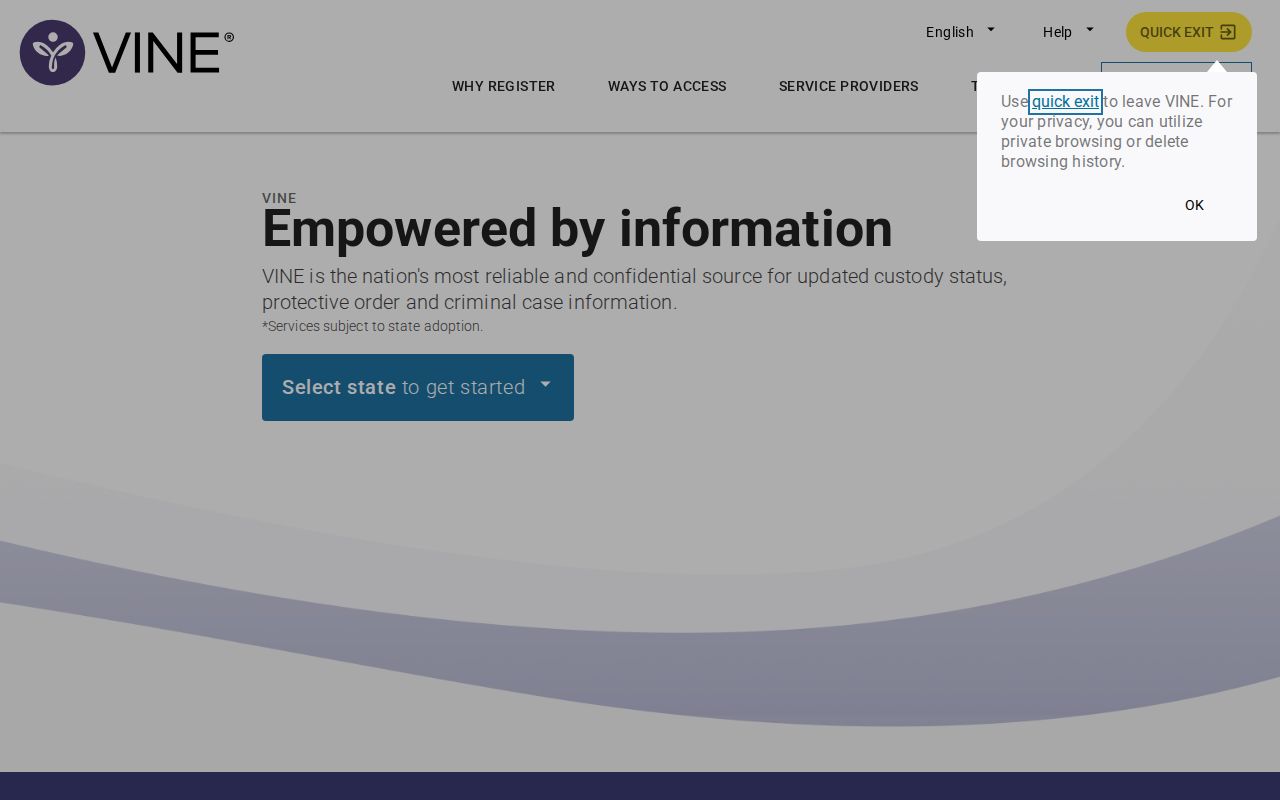
Checking the right system prevents a custody alert from being mistaken for a Dodge County registry update.
Common-Name Dodge County Registry Matches
When several results share a name, do not infer identity from the first row. Compare aliases, released birth or age data, physical traits, residence, conviction county, offense details, and vehicle information. A current address alone may not settle the match because a move can be in progress or the person may be incarcerated. Open the printable detail and map only after comparing stable identifiers.
If a Dodge County profile appears inaccurate, questions and registration updates go to Wisconsin DOC at 608-240-5830. Suspected noncompliance can be reported to the Safe Tip Line at 1-877-234-0085 or to local law enforcement. Do not confront the person. A registry mismatch is a reason to seek official clarification, not a basis for public accusation.
Using Registry Information Lawfully
Registry information exists for awareness and safety planning. Use it to understand a released profile, choose notification settings, and share a concern with the proper agency. Community notice does not authorize private enforcement. A registry appearance does not prove a new offense, current dangerous conduct, or an active Dodge County criminal case.
Use registry data lawfully: Misusing registry information to harass, threaten, intimidate, or take vigilante action is a crime under Wisconsin law. Wis. Stat. § 301.46 governs access and community notification; report concerns to law enforcement instead of confronting a registrant.
Keep public-safety use separate from decisions regulated by the Fair Credit Reporting Act. Verify all material facts through Wisconsin DOC, law enforcement, or the originating court before relying on them.